

Door closer repair in San Francisco: what we fix
We service surface-mounted, concealed and parallel-arm closers on commercial doors across San Francisco. Most calls are fixed with an adjustment on the first visit; a closer that leaks oil is replaced. Door closer replacement costs $250–$500 installed, depending on the closer grade, size and arm type. Every visit starts with a $29 service call and a quote before work begins.
Common door closer problems
| Problem | Usual cause | Fix |
|---|---|---|
| Door slams shut | Sweep or latch valve open too far | Adjust valves, set backcheck |
| Door will not close all the way or latch | Latch speed too slow, spring too weak for the door, misaligned strike | Adjust latch speed and spring power, realign door and strike |
| Door closes too slowly | Valves closed down, or cold weather thickening the fluid | Open sweep and latch valves in small steps |
| Oil on the floor or closer body | Failed internal seal | Replace the closer; leaking closers cannot be refilled |
| Door swings open in the wind or hits the wall | No backcheck, broken arm or stop | Set backcheck, replace the arm or add a hold-open stop |
What are the 1 and 2 screws on a door closer?
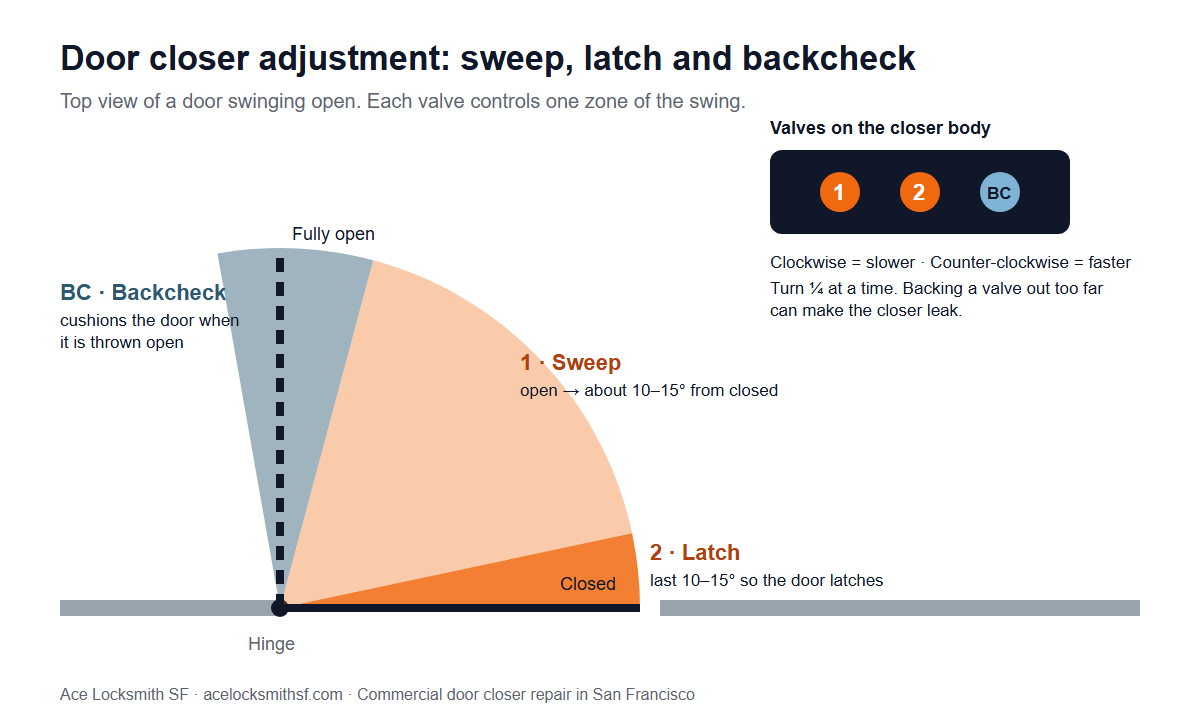
Most closers have two speed valves, often stamped 1 and 2 or S and L:
- 1 / S (sweep): the speed from fully open to about 10–15 degrees from closed.
- 2 / L (latch): the speed over the last few degrees, so the door closes firmly enough to latch without slamming.
- BC (backcheck), if present: slows the door when it is thrown open, protecting the wall and the hinges.
Turn valves a quarter turn at a time. Clockwise slows, counter-clockwise speeds up. Backing a valve out too far can make the closer leak, which is the most common reason a DIY adjustment ends in a replacement.
The three adjustments on a door closer
- Sweep speed (valve 1 / S): how fast the door travels from open to about 10–15 degrees from closed.
- Latch speed (valve 2 / L): the final few degrees, set so the door latches without slamming.
- Backcheck (BC): cushions the door when it is thrown open so it does not hit the wall or strain the hinges.
Some closers add a fourth, delayed action (DA), which holds the door open a few seconds longer for carts or wheelchairs.
How to adjust door closer tension (spring power)
Speed and tension are different settings. The valves change speed; spring power changes how hard the closer pushes the door shut. On adjustable-size closers, the spring is set with an adjusting nut or screw on the closer body, usually marked in sizes from 1 to 6. Increase it for heavy doors or entrances that catch wind; decrease it if the door is hard to open. Interior doors covered by accessibility rules are limited to about 5 lbf of opening force, so more power is not always the answer.
Which door closer do I need?
- Door size and weight: sets the closer size or spring power.
- Mounting: regular arm on the pull side, parallel arm on the push side (common on storefronts), or top-jamb mount.
- Grade: grade 1 for exterior and busy commercial doors.
- Fire rating: fire doors need a listed closer and no hold-open unless it releases on alarm.
- Extras: hold-open arm, delayed action, or a stop to protect the wall.
Not sure? Send us a photo of the door and the current closer and we will tell you what fits.
Grade 1 vs grade 2 vs grade 3 door closers
| ANSI/BHMA grade | Built for | Typical doors |
|---|---|---|
| Grade 1 | Heavy commercial use, highest cycle testing | Storefront and building entrances, schools, busy offices |
| Grade 2 | Medium commercial use | Interior office doors, low-traffic back doors |
| Grade 3 | Light use | Residential and very light commercial doors |
For any exterior or high-traffic door in San Francisco we recommend grade 1. Wind on exposed entrances and heavy aluminum storefront doors wear out lighter closers fast.
Door closers, panic bars and fire doors
A fire-rated door must close and latch on its own, so its closer has to be working and adjusted. On exit doors, the closer and the panic bar work together: a weak closer is the most common reason an exit door does not latch. We check both on the same visit.
Commercial door closer service across San Francisco
Ace Locksmith SF is a licensed commercial locksmith (CA License #7929) serving offices, storefronts, restaurants and apartment buildings throughout San Francisco, 7 AM–11:30 PM, 7 days a week. Call (415) 205-5718.